
The Great Britain–Portugal telegraph cable, laid in 1870, created a fast, direct communication link between the two long-allied nations. The line connected Porthcurno, Cornwall, to Carcavelos, near Lisbon, a major European telegraph hub. It formed part of the expanding European telegraph network and strengthened connections to Portugal’s overseas territories.
The cable significantly reduced message transmission time, from days by sea to minutes, supporting diplomacy, trade, and coordination across wider global routes. It also helped integrate southern Europe more tightly into Britain’s worldwide telegraph system, linking onward to Africa, India, and the Far East.
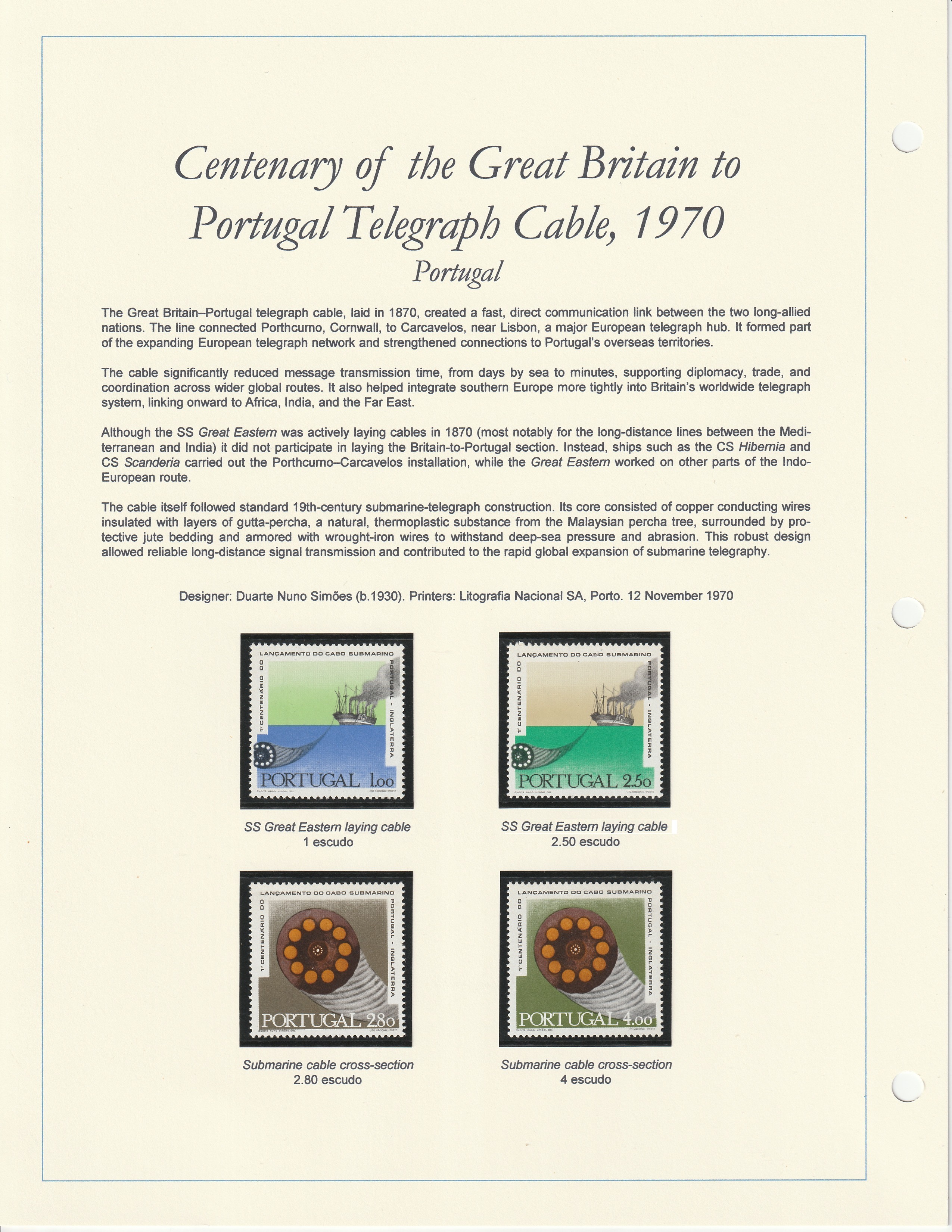
1 and 2.50 escudo stamps: Although the SS Great Eastern was actively laying cables in 1870 (most notably for the long-distance lines between the Mediterranean and India) it did not participate in laying the Britain-to-Portugal section. Instead, ships such as the CS Hibernia and CS Scanderia carried out the Porthcurno–Carcavelos installation, while the Great Eastern worked on other parts of the Indo-European route.
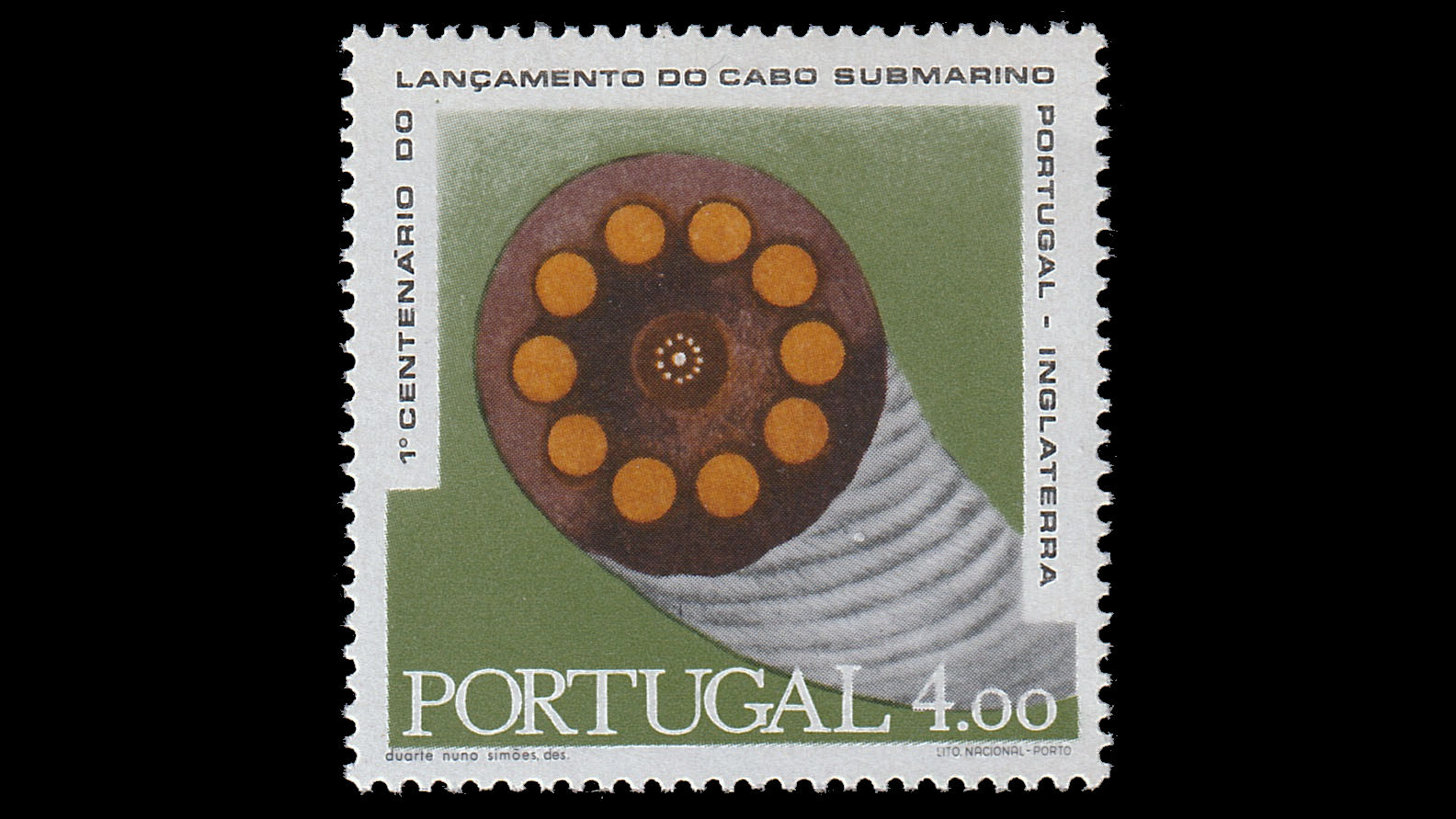
2.80 and 4 escudo stamps: The cable itself followed standard 19th-century submarine-telegraph construction. Its core consisted of copper conducting wires insulated with layers of gutta-percha, a natural, thermoplastic substance from the Malaysian percha tree, surrounded by protective jute bedding and armored with wrought-iron wires to withstand deep-sea pressure and abrasion. This robust design allowed reliable long-distance signal transmission and contributed to the rapid global expansion of submarine telegraphy.
 (opens in a new tab)
Portugal